


“The famine is over! The famine is over! The curse be damned! Hit the nuclear button!
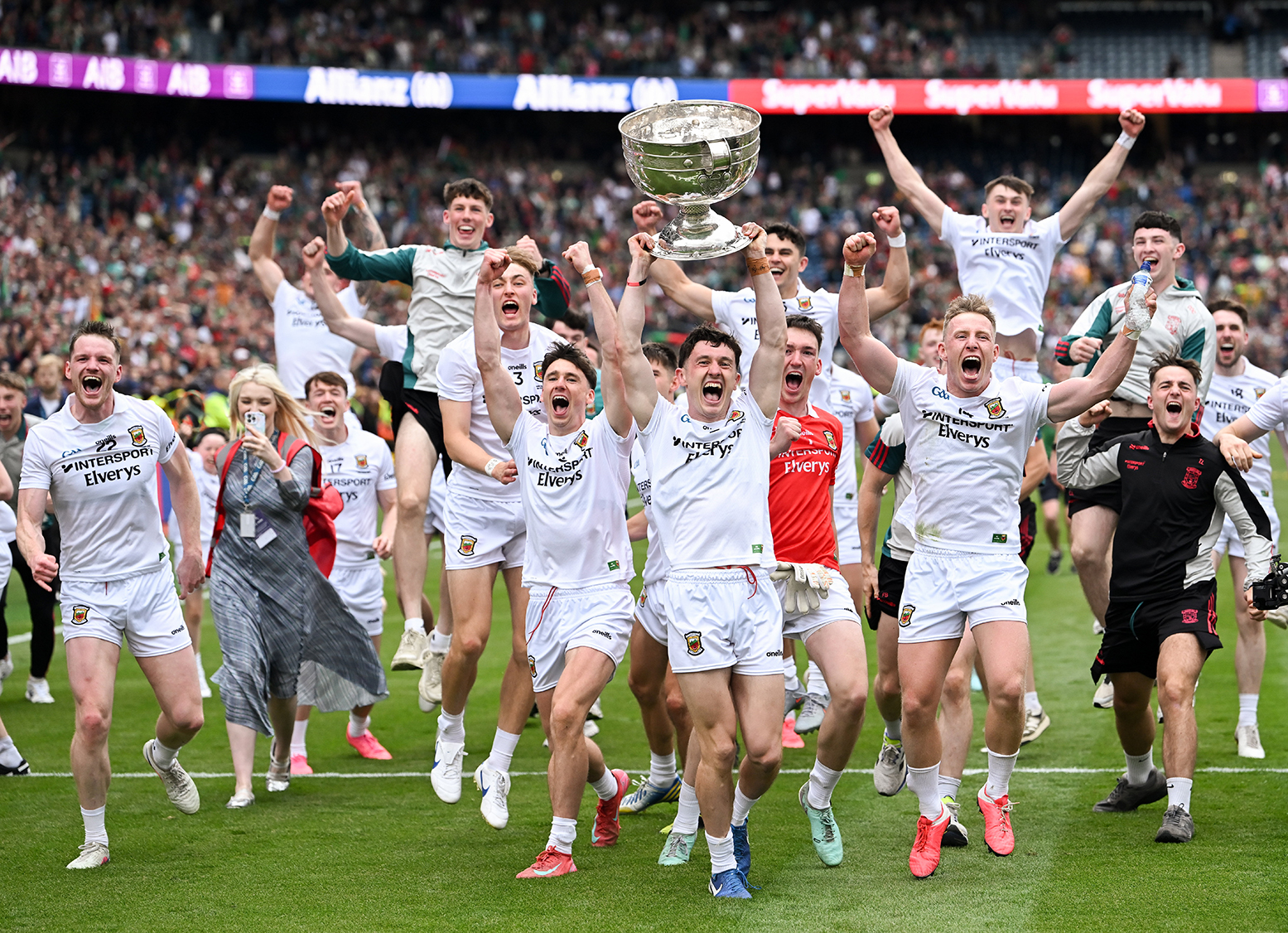
Mayo have won the All-Ireland! Sam Maguire is coming home!”. If you have even a passing familiarity with sport-posting online, it’s likely you’ve heard those words – not quite spoken or screamed, but yelped with throat-cracking timbre – by Midwest Radio’s Stephen Grealis on Sunday, 26 July. More likely, you’ve heard them transposed over the dramatic final moments of the game on which he was commentating: the 2026 All-Ireland Gaelic football final between Mayo and Kerry.
For the uninitiated, and with sincere apologies to every other Irish sporting occasion, the All-Ireland football final, in which the coveted Sam Maguire Cup is awarded, is the biggest event in the Irish sporting calendar. This year’s final was arguably the most momentous in many years. Watching from London, however, I was struck by the extent to which the match had become an international spectacle, and by the number of heads of state (Joe Biden and Mark Carney, to name but two), commentators and influencers from outside Ireland who were engaged with it play by play, video by video and, inevitably, with one eye trained on “the Mayo curse”. A précis of this well-told tale may be in order: in 1951, on the journey home after beating Meath in that year’s All-Ireland final in Dublin, the Mayo team is said to have encountered a funeral cortège passing through the local town of Foxford.
Funeral processions are slow and solemn affairs, and Irish tradition dictates that any traffic encountering such a cortège must slow to match its pace and join the mourners in pin-drop silence. This, the story goes, the Mayo players neglected to do, refusing to slow down or cease the rowdy celebrations in which they were indulging atop the open-top lorry that was conveying them back to home base. Aghast at this behaviour, the priest leading the funeral is said to have issued the following, stirring malediction: “Damnation be upon every one of you; as long as you all shall live, County Mayo will never win another All-Ireland.” It’s a pleasingly prolix, if unlikely, quotation, but fast-forward to 2026 and Mayo, despite their victory in 1951 being their second in succession, had not won another since. That was until Sunday, when, after 75 years and 11 fruitless finals, Mayo won their fourth Sam Maguire trophy – three years after the final living occupant of that ill-omened lorry had passed away.
This tale is an excellent hook upon which to hang a newfound global interest in an obscure national sport, so perhaps all this attention is self-explanatory. But many Irish people have, like myself, noted this uptick for some time now: an increasing, slightly befuddled interest in Ireland’s Gaelic games among posters in the UK and US. The emergence of footballers Lee Keegan and Owen Mulligan as memes on Spanish-language X posts during the World Cup also marked a particularly striking escalation. Among UK converts, comparisons between soccer and Gaelic football were pervasive, with special attention given to the speed, intensity and high-scoring nature of the Mayo-Kerry showdown.
More than that, a certain wistfulness was detectable among these commenters. They admired a sport that had resisted commercialisation to the extent that none of the athletes are paid; whose hard-fought rivalries, some forged through more than a century of acrimonious on-field battles, so rarely spill over into violence; whose showpiece cup final attracts mammoth crowds and huge viewership while charging only a third of the price of a mid-table Premier League match; and whose central place in Ireland’s cultural identity has never calcified into the nativist or xenophobic tendencies that have occasionally complicated England’s football culture. On a practical level, the surge of interest has more prosaic explanations. Both football and hurling are fast-paced, exciting games that are filmed to a very high standard, meaning their highlights simply make for excellent clips.
Good sport tells good stories. And the existence of such a modern yet pleasingly alien sport creates an irresistible dissonance for a sport-mad online audience. When the mildest context is introduced – an underdog, an unprecedented match-up, a 75-year curse – these sports’ innate capacity for high-octane storytelling is irresistible. In Ireland, football, hurling and camogie (hurling’s female variant) comprise the most popular sports in the country.
All are administered by the Gaelic Athletic Association (GAA) – a 141-year-old organisation of which every single Irish citizen is aware, of which a solid plurality are massive fans, and of which 10 per cent are members. (There is another indigenous sport, unadministered by the GAA, that has received less attention for its Irish origins – perhaps because croquet’s air of stuffy refinement does not quite cleave to the hard-boiled stereotypes associated with the former.) Each of those sports is unique to Ireland, played amateur level, and typified by fast-paced action and superhuman physicality. This ruggedness is ripe for comparison with the more polished world of simulation and soft fouls that now typifies soccer. A glance at the replies to videos of GAA matches does indicate that macho fetishisation is at work – a phenomenon typified by macho archetype Jason Statham describing hurling as “a cross between hockey and murder” in the 2011 action thriller Blitz. Were Gaelic games merely “tough guy stuff”, they would likely exist within that same cycle that rugby and Aussie Rules so often circulate in American minds: unvarnished alternatives to their own pasteurised and bloated sports.
Where Gaelic games derive further fascination is from the more values-led component of their appeal: the fact that they are played by athletes who take no wage and represent only their own locales, and where an intense culture of sportsmanship abides even within bitter rivalries. In that sense, they are perfect catnip for fans increasingly irate about the drudgery and sham of their own favourite sports. And while it is obviously a polite fiction that there is zero money, cheating or nastiness in the GAA, there is so little of it compared with almost any other major sport that comparing its governing body with, say, Fifa creates a laughable contrast in the former’s favour. The sport’s intrigue abroad may be tied to a broader malaise with the excess and grotesquery of more established global games – all of which are conveniently off-season during the All-Ireland finals.
That, of course, and the innate pull of the supernatural. Perhaps aggravated by our superstitious ways, the BBC sent American GAA fan Dave McKenna to Foxford in 2023, for its three-part history series, The Mayo Curse. There, he found no supporting evidence for its provenance whatsoever; no contemporary reports or subsequent accounts of the events described, nor even a conceivable candidate for a funeral an open-top lorry could have passed on that date, in any nearby parish record. There was, in fact, no trace to be found of this hex anywhere, no mention online or off, before the year 2001.
Sport, however, is about storytelling. And why, for the love of Sam, would we let the truth get in the way of a good story? [Further reading: So you want to be Irish?]
