

Olympics
Gurudev Sri Sri Ravi Shankar at SPIEF 2026: Wellness, Culture and Human Values Key to Future Economies
republicworld.com
•4 June 2026, 4:01 PM
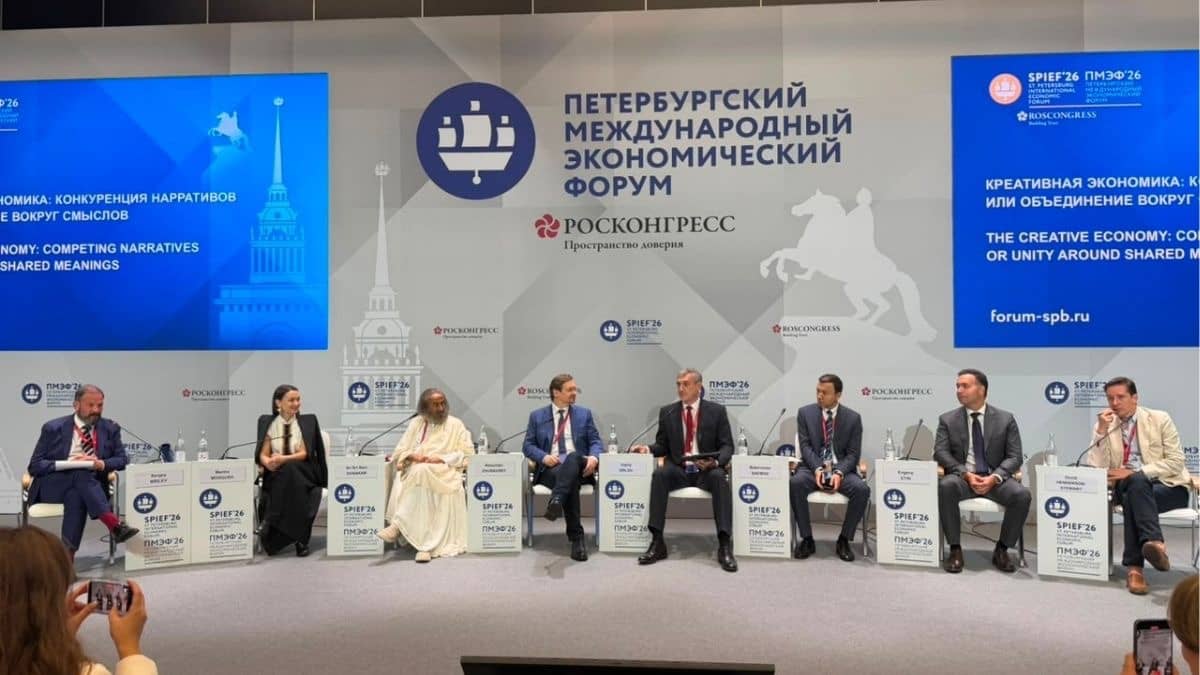

Bengaluru: In a significant recognition of the growing role of culture, spirituality, mental wellbeing and shared human values in shaping the future of economies, the global spiritual master and humanitarian leader, Gurudev Sri Sri Ravi Shankar, founder of The Art of Living, addressed the coveted St. Petersburg International Economic Forum (SPIEF) 2026, held under the auspices of the President of the Russian Federation, Vladimir Putin. Gurudev's participation emphasises a notable shift in global conversations around economic growth and development. Alongside discussions on investment, innovation, trade, and AI, there is increasing recognition that culture, mental well-being, social trust, and human connection are becoming essential pillars of long-term prosperity and co-operative wealth generation.
A central theme of Gurudev's address was the growing relevance of wellness in the global economy. As nations grapple with rising stress, anxiety, and mental health challenges and the rapid growth of the wellness economy, he pointed to India's leadership in preventive healthcare through yoga, Ayurveda, and traditional healing systems. "Prime Minister Shri Narendra Modi ji created the Ayush Ministry, which is promoting yoga, herbal medicine and holistic wellness. This itself will help the whole world." Gurudev emphasized that human well-being and tools to address this is no longer a peripheral concern but a fundamental economic priority.
"One in every four persons today faces mental challenges. In this situation, wellness through yoga, music, and meditation is more crucial than ever," Gurudev said. Noting that Russia already has a strong interest in yoga and wellness practices, he said the two countries are uniquely positioned to collaborate in this rapidly expanding sector. Speaking on the future of Indo-Russian cooperation, Gurudev identified tourism, wellness, and student exchange as three sectors with immense untapped potential.
Highlighting the complementary strengths of the two countries, he noted that greater tourism can foster deeper people-to-people ties and unlock new economic opportunities. Calling student exchanges a vital investment in future relations, Gurudev advocated for stronger educational and language partnerships between the two nations. Referring to a memorandum of understanding signed a day earlier between Sri Sri University in Odisha and Ural Federal University in Yekaterinburg, he said, "Universities can become a nurturing ground for mutual cooperation" that can deepen the longstanding friendship between India and Russia.
Addressing policymakers and industry leaders, Gurudev opined that culture should not be viewed merely as entertainment or heritage, but as a powerful force for fostering social cohesion, economic vitality, and international understanding. Drawing from nearly two decades of leadership of the World Culture Festival, arguably one of the largest celebrations of cultural diversity in the world, he shared how music, art, food, and shared experiences can bring together people from vastly different backgrounds, with some even in the throes of conflict. "There is Olympics for sports, but there is nothing similar for people who love art and culture. That is why we created the World Forum for Art and Culture and the World Culture Festival," Gurudev said.
Gurudev recounted how the World Culture Festival has brought together artists and participants from across continents, including strong participation from Russia, creating spaces where cultural exchange and creativity can thrive without competitiveness. From Germany's Olympic Stadium to New Delhi's historic gathering of more than 3.75 million participants and 36,602 artists, the festivals have demonstrated how cultural engagement can strengthen tourism, support local economies, and create meaningful connections among communities. "We can create happier societies by encouraging non-competitive cultural activity," Gurudev said. "People from different countries came together, discovered new music, new traditions, and bonded like family," he said.
Importantly, WCF was not just about celebrities performing, but a truly democratized space for artists across nations and backgrounds passionate about their art form to showcase their talent on a global stage. Gurudev joined an influential panel that included Denis Alipov, Ambassador Extraordinary and Plenipotentiary of the Russian Federation to the Republic of India; Lokesh Nara, Minister of Information Technology, Electronics and Communications, Government of Andhra Pradesh; Vinay Kumar, Ambassador Extraordinary and Plenipotentiary of the Republic of India to the Russian Federation; Sergey Cheremin, Minister, Government of Moscow; Head of the Department for External Economic and International Relations of Moscow; Alexey Chekunkov, _Minister of the Russian Federation for the Development of the Far East and the Arctic; and Vasily Orlov, Governor of the Amur Region, among others. As governments and institutions search for new models of sustainable development in an increasingly interconnected world, Gurudev's message offered a timely reminder that the most enduring economies are built not only on innovation and capital, but also on trust, creativity, and a shared sense of humanity.
